
PROP HOURS BLOG
Are Airbnb Startup Costs Tax Deductible? What to Deduct, Depreciate or Amortize
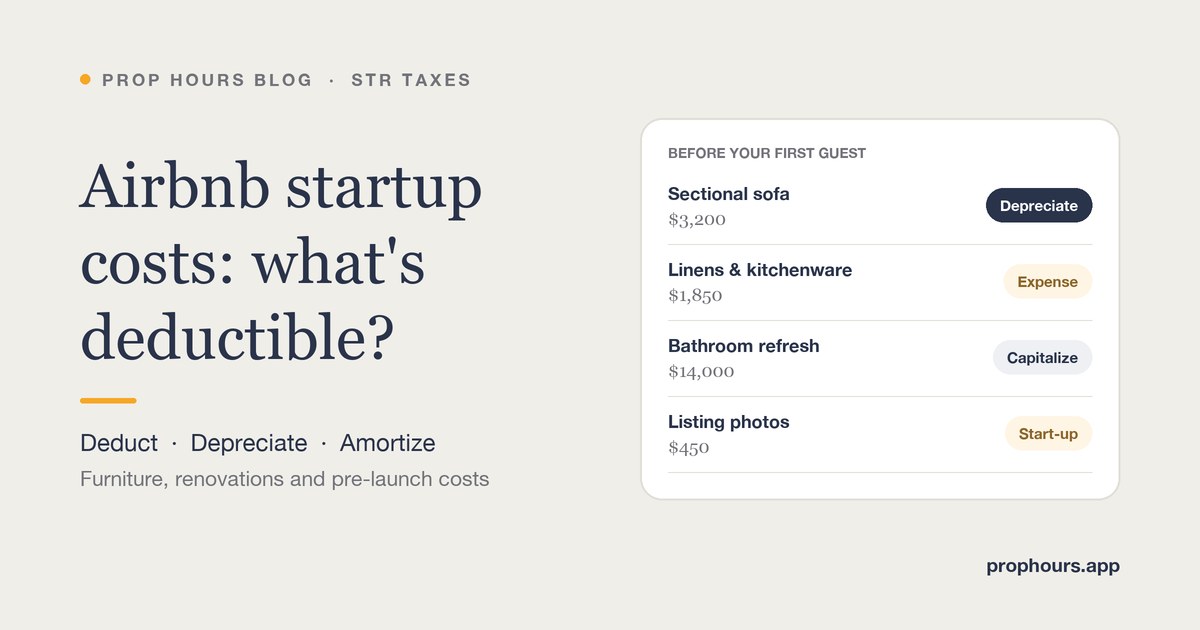
In short: most Airbnb startup costs are tax deductible, just not all at once. Once your rental is ready and available for rent, ordinary operating costs are deductible rental expenses. Before that date, furniture and appliances are depreciated, small items can be expensed under the $2,500 de minimis safe harbor, renovations and closing costs are added to the property’s basis, and true start-up costs such as market research and pre-launch marketing can be deducted up to $5,000, with the rest spread over 15 years.
Free Airbnb startup cost tracker
Enter each purchase and pick a category: the sheet fills in the likely tax treatment, totals each bucket and estimates your start-up cost deduction. Works in Excel, Numbers and Google Sheets.
Priya closed on a two-bedroom condo on March 14. In April she refreshed the bathroom and floors, bought a $3,200 sectional and $1,850 of linens, kitchenware and decor, and paid a photographer $450 for listing photos. Her listing went live and bookable on June 1; her first guest checked in on June 20. Each of those costs is handled differently on her tax return, and the date that decides most of it is June 1, not the day of her first booking.
The date that matters: when your rental is placed in service
A rental is placed in service when it is ready and available for rent. IRS Publication 527 gives the example of a house bought in April, repaired, and ready for rent in July: it is placed in service in July, when it was ready and available for rent. No guest has to have arrived yet. For an Airbnb, that usually means the day it is furnished, listed and bookable.
That date does three things. Depreciation starts. Ordinary costs of managing and maintaining the rental become deductible, because Publication 527 allows them from the time you make the property available for rent. And your rental activity begins, which matters for material participation. Save proof of the date, such as a screenshot of the listing going live or the calendar opening.
Startup cost checklist: deduct, depreciate or amortize
| Cost | Before it’s available for rent | After it’s available for rent |
|---|---|---|
| Furniture and appliances over $2,500 per item | Depreciate over 5 years; 100% bonus depreciation may apply | Same |
| Linens, kitchenware, decor and other items of $2,500 or less | Expense under the de minimis safe harbor, if you elect it | Same |
| Renovations and improvements | Add to the property’s basis and depreciate | Improvements: capitalize. Repairs: deduct |
| Closing costs to buy the property | Add to the property’s basis | — |
| Market research, listing photos, pre-launch ads, setup consultants | Start-up cost: up to $5,000 in the first year, the rest over 180 months | Deduct as a rental expense |
| Cleaning, supplies, platform fees, insurance, utilities | Generally not deductible yet; ask your CPA how to treat them | Deduct as rental expenses |
| Mortgage interest and property taxes | Not start-up costs; the treatment depends on your situation | Deduct as rental expenses |
Furniture: depreciation, bonus depreciation and the $2,500 rule
Furniture, appliances and carpeting used in a residential rental are 5-year property, according to Publication 527. Normally that means deducting them over several years. But the law signed on July 4, 2025 made 100% bonus depreciation permanent for eligible property acquired and placed in service after January 19, 2025, so Priya’s $3,200 sectional can be written off in full in her first year unless she elects out.
Smaller purchases can skip depreciation entirely. Under the de minimis safe harbor, owners without audited financial statements can expense items costing $2,500 or less per invoice or per item, as long as they attach the election statement to that year’s return. Priya’s linens, kitchenware and decor fit comfortably.
Improvements to the building itself are different: they are added to the property’s basis and generally depreciated over 27.5 years, which is too long for bonus depreciation. A cost segregation study can reclassify parts of the building into shorter lives that do qualify. And check your state: some, such as California, do not follow federal bonus depreciation.
True start-up costs: the $5,000 rule
Costs of investigating and launching the business — market research, listing photos, pre-launch advertising, a setup consultant — are start-up costs under Section 195. If you elect it, you can deduct up to $5,000 in the year the business begins. That $5,000 shrinks dollar for dollar once total start-up costs pass $50,000 and disappears at $55,000. Whatever is left is amortized evenly over 180 months, starting with the month the business began.
Priya’s $450 of photos is deductible in full in 2026. An owner with $58,000 of start-up costs would get no immediate deduction and would amortize about $322 a month instead. One catch: the start-up rules apply to an active trade or business. Many short-term rentals that provide substantial services are; a hands-off rental may be treated differently, so confirm with your CPA.
Where the first-year loss goes
Bonus depreciation, de minimis purchases and start-up deductions often turn a short-term rental’s first year into a tax loss. Whether that loss can offset your W-2 or other income depends on the passive activity rules. With an average guest stay of seven days or less and material participation, it generally can, subject to other limits — that is the short-term rental tax loophole. Without them, the loss is usually suspended and carried forward.
Do setup hours count toward material participation?
Generally not for the rental itself. The rental activity typically begins when the property is placed in service, so hours spent researching, buying and setting it up usually fall before the activity exists, and investor-type work such as analyzing deals never counts. Some acquisition work can count toward the 750-hour test for real estate professional status, because acquisition is part of a real property trade or business.
Log those hours anyway, with dates, and let your CPA decide. Then start a contemporaneous log the day the listing goes live. Our free material participation log template is built for exactly that, or you can log by timer, voice or receipt scan in the PropHours app.
Are Airbnb startup costs tax deductible?
Most are, but not all at once. Once your rental is ready and available for rent, operating costs are deductible as rental expenses. Before that, furniture is depreciated, small items can be expensed under the de minimis safe harbor, renovations and closing costs are added to the property's basis, and true start-up costs can be deducted up to $5,000, with the rest amortized over 180 months.
Can I write off furniture for my Airbnb?
Yes, through depreciation. Furniture and appliances in a residential rental are 5-year property, and items acquired and placed in service after January 19, 2025 can qualify for 100% bonus depreciation in the first year. Items of $2,500 or less per invoice or item can be expensed if you elect the de minimis safe harbor.
When is a short-term rental placed in service?
When it is ready and available for rent: furnished, listed and bookable. That can be before your first guest arrives. Keep a record of the date, such as a screenshot of the listing going live, because depreciation and rental expense deductions start from it.
What if my startup costs are more than $50,000?
The $5,000 first-year deduction shrinks dollar for dollar above $50,000 and disappears at $55,000. Whatever you can't deduct right away is amortized evenly over 180 months, starting with the month your rental business began.
Do hours spent setting up my Airbnb count toward material participation?
Generally not for the rental itself. The rental activity typically begins when the property is placed in service, and research or investor-type work never counts. Some acquisition work can count toward the 750-hour test for real estate professional status, so log it with dates and let your CPA decide.
Related reading
Once you are open, work through the Airbnb tax deductions checklist, see how a cost segregation study accelerates depreciation, and track your hours from day one with the free log template.
This article explains general federal rules as of September 2026 and is not tax advice. The example is illustrative. Whether a cost is deductible, depreciable or a start-up cost depends on your facts, elections and state rules; review IRS Publication 527 and consult a qualified tax professional. PropHours records your work; it does not determine tax treatment or eligibility.