
PROP HOURS BLOG
How CPAs Can Verify a Client’s Material Participation Hours
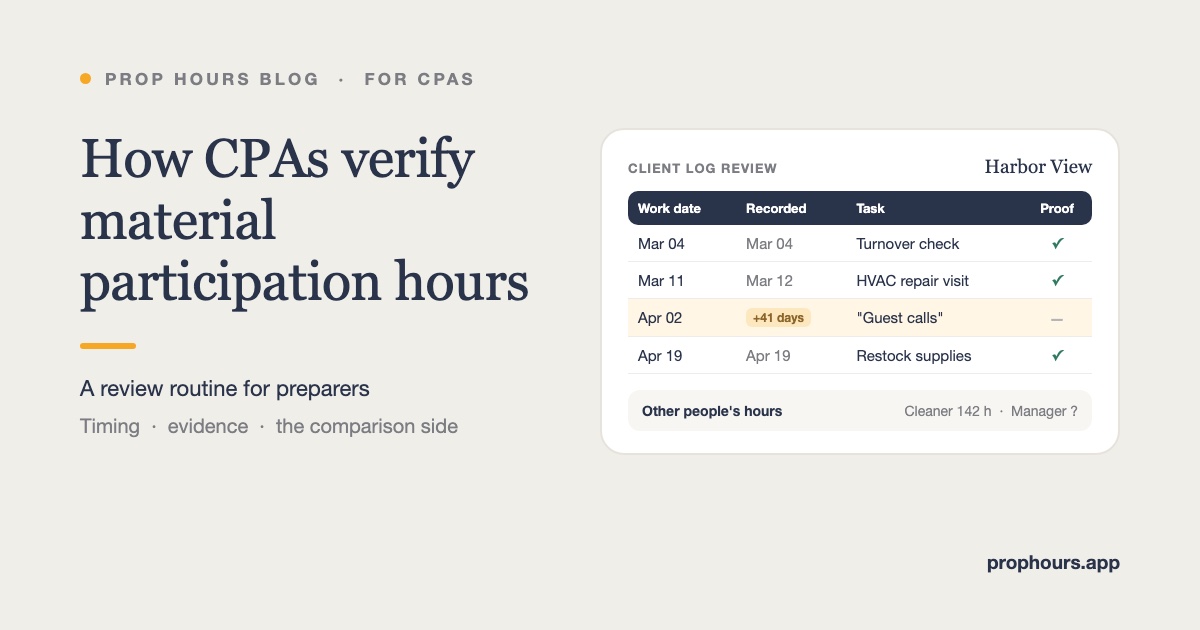
In short: you can generally rely on a client’s hour log in good faith, but you can’t ignore what it implies. Before you treat a rental loss as nonpassive, confirm the regime (real estate professional status, the seven-day rule or neither), the material participation test the client is claiming and who else worked on the property. Then test the log for timing, detail, plausibility and evidence, remove the hours that don’t count, and document what you asked.
Most material participation advice is written for the owner. This article is for the CPA, EA or other preparer who receives that log in February. You aren’t required to audit a client’s records, and you shouldn’t build the log for them. But the hours decide whether the loss is passive, and the logs that fail in Tax Court tend to show the same warning signs. Here is a review routine to run before you sign.
Where your duty to ask begins
Circular 230 §10.34(d) says you “generally may rely in good faith without verification upon information furnished by the client,” but you may not “ignore the implications” of it, and you must make “reasonable inquiries” if it appears incorrect, inconsistent or incomplete. Treas. Reg. §1.6694-1(e)(1) says the same for the preparer penalty and adds that you “must make appropriate inquiries” into facts the Code or regulations make a condition of a deduction. The AICPA’s tax standards follow the same pattern (¶2.3.2) and reach further: ¶2.3.3 asks for reasonable inquiries whenever the law imposes a condition regarding the “deductibility or other tax treatment of an item.”
Material participation decides whether a rental loss is passive, so in our reading the client’s hours are among the facts those inquiry rules reach. The stakes are personal: if part of an understatement is due to an unreasonable position you knew or reasonably should have known about, the §6694(a) penalty is the greater of $1,000 or 50% of the income you derive from the return, rising to $5,000 or 75% under §6694(b) for willful or reckless conduct. Reasonable inquiry isn’t an audit. It is asking the questions the file raises and writing down the answers.
Step 1: Identify the regime and the activity
Hours matter only where the rules ask for them, so sort each property first:
- Long-term rental, no REPS: passive “without regard to whether or not the taxpayer materially participates” (§469(c)(2) and (c)(4)), so the hour log doesn’t change the result. The $25,000 allowance in §469(i) turns on active participation, not hours.
- Short-term rental: not a rental activity if the average period of customer use is seven days or less, or 30 days or less with significant personal services (Temp. Reg. §1.469-1T(e)(3)(ii)(A) and (B)). The loss is nonpassive only if the client materially participates; REPS isn’t needed. Compute the average from booking data, not the log: total days in all stays divided by the number of stays (Reg. §1.469-1(e)(3)(iii)(C)); if one activity holds properties with very different daily rents, the averages are weighted by rental income.
- Real estate professional (REPS): the client needs more than 750 hours, and more than half of all personal services in trades or businesses, in real property trades or businesses in which they materially participate (§469(c)(7)(B)). One spouse must meet both tests alone. Hours as an employee count toward total personal services, but not as real property hours unless the client owns more than 5% of the employer (§469(c)(7)(D)(ii); Reg. §1.469-9(c)(5)). Each rental still needs material participation.
Then pin down the activity. Without the §469(c)(7)(A) election, a REPS client’s rentals are tested one by one, so you need hours per property. The election is a statement filed with an original return (Reg. §1.469-9(g)(3)), or a late election under Rev. Proc. 2011-34 attached to an amended return; find it rather than taking the client’s word. In Hailstock v. Commissioner, T.C. Memo. 2016-146, “simply listing multiple rental properties on a Schedule E, without more, is insufficient.” A short-term rental can’t ride along with the election: Bailey v. Commissioner, T.C. Memo. 2001-296, and Ellison v. Commissioner, T.C. Memo. 2017-134, each required it to pass material participation on its own.
Step 2: Name the test, then find the comparison side
Temp. Reg. §1.469-5T(a), issued in 1988 and still in force, sets out seven tests. Ask which one the client relies on for each property, because the evidence you need differs:
- More than 500 hours ((a)(1)): no comparison, so the volume itself has to hold up.
- More than 100 hours and not less than any other individual ((a)(3)), “including individuals who are not owners”: the cleaner, co-host, handyman and property manager.
- Substantially all of the participation of all individuals ((a)(2)): rarely available once a cleaner or manager does real work.
- Facts and circumstances ((a)(7)): regular, continuous and substantial participation and more than 100 hours, and the client’s management hours don’t count if anyone else is paid to manage or any individual puts in more management hours ((b)(2)(ii) and (iii)). A paid manager usually rules it out.
- Five of the prior ten years ((a)(5)): the evidence is in old files.
The other two, significant participation activities ((a)(4)) and personal service activities ((a)(6)), seldom decide a rental file.
“More than” means exactly 100 or exactly 500 hours fails. And the comparison tests can’t be verified from the client’s log alone. In Lucero v. Commissioner, T.C. Memo. 2020-136, a short-term rental claim failed partly because “the record does not include any documents that show the number of hours other individuals, such as Sea Ranch Escapes, spent on those activities.” Bailey had the same gap, and so did the student rental in Mirch v. Commissioner, T.C. Memo. 2025-128, which the owners paid their daughter to manage. Our 100-hour trap article walks through the comparison from the owner’s side.
Step 3: Test the log, not just the total
Contemporaneous logs “are not required” if participation can be shown by other reasonable means, such as appointment books, calendars or narrative summaries (Temp. Reg. §1.469-5T(f)(4)). The Tax Court has set the limit: “We have held that the regulations do not allow a postevent ‘ballpark guesstimate’” (Moss v. Commissioner, 135 T.C. 365, 369 (2010)). Four checks tell you whether a log is a reasonable means:
- Timing. When was each entry written, and from what? In Bailey, the owner assigned hours years later for trial, “based solely on her judgment and experience,” and the estimates failed. In Lucero, a log rebuilt at IRS Appeals from receipts and invoices failed because its entries were inflated and mixed in investor, commuting and personal time. But Leland v. Commissioner, T.C. Memo. 2015-240, a farm case, accepted logs rebuilt for trial from a work calendar, credit card receipts and invoices, backed by credible testimony. A rebuild can work; what it rests on, and whether each entry holds up, is the point.
- Detail. Each entry needs the work and the time. In Bailey, calendars that showed visits but no hours couldn’t support the estimates built on them. In Moss, the calendar listed tasks without times, so the hours rested on an estimated summary, which still came to less than 750.
- Plausibility. Add up the days. Escalante v. Commissioner, T.C. Summ. Op. 2015-47, featured a 25-hour day. Standardized blocks are the quieter version: 121 entries of exactly one hour in Hairston v. Commissioner, T.C. Memo. 2019-104, and 7 hours of cleaning per stay in Mirch.
- Corroboration. The wins had paper behind them: a detailed contemporaneous log in Leyh v. Commissioner, T.C. Summ. Op. 2015-27, and receipts and emails in Franco v. Commissioner, T.C. Summ. Op. 2018-9. Summary opinions aren’t precedent, but they show what persuades the court.
Step 4: Take out the hours that don’t count
Before you compare totals with thresholds, strip out:
- Investor-type work, such as reviewing statements or monitoring finances, unless the client is “directly involved in the day-to-day management or operations” (§1.469-5T(f)(2)(ii)). In Lucero, paying bills and coordinating with the manager were investor time because the manager ran operations.
- On-call and waiting time. Moss excluded on-call time because no work was performed, and Hairston rejected a week of “supervising” painters: “we cannot believe that he spent an entire week watching paint dry.”
- Time outside the activity: before the client owned the property or tried to rent it, and time spent writing up the log (Ellison; Reg. §1.469-5(f)(1)).
- Padding: work not of a type an owner customarily does, when one of the principal purposes is to avoid the passive loss rules (§1.469-5T(f)(2)(i)).
- Travel, provisionally. Ellison and Lucero treated driving between home and the property as commuting. Leyh counted travel to the rentals, and in Leland the IRS didn’t dispute long trips the court found integral to the farm work. Have the client log it on separate lines, and check whether the test passes without it.
Step 5: Check the spouse, the day job and the return
The spouse. A spouse’s work counts for material participation, owner or not (§469(h)(5); §1.469-5T(f)(3)). For REPS it still counts in deciding which real property businesses the client materially participates in, but not toward the 750-hour and more-than-half tests, which one spouse must meet alone (§469(c)(7)(B); Reg. §1.469-9(c)(4)). So a REPS log must say who did each task. In Hairston it didn’t, and in Escalante the husband’s log included his wife’s tasks.
The day job. The more-than-half test has a denominator. The IRS’s 2005 passive activity loss audit technique guide, now marked obsolete, told examiners that a 2,080-hour job needs 2,081 real property hours, and to “check occupations by signatures and W-2s.” Escalante understated his teaching hours, and in Hakkak v. Commissioner, T.C. Memo. 2020-46, there were no calendars or timesheets for the law practice.
The return. In Mirch, the owner’s cleaning hours sat next to nearly $10,000 of professional cleaning deductions and an $85 cleaning fee charged to guests. Management fees, cleaning, labor and commissions on Schedule E each point to someone else’s hours, and personal-use days and closing dates should fit the log too.
Red flags, the question to ask and what resolves it
| Red flag | Question to ask | What resolves it |
|---|---|---|
| Round or identical durations (Hairston; Mirch) | How was the time measured? | Start and end times, timer records, message timestamps |
| A log that first appears at year-end or after an IRS challenge (Lucero; Bailey) | When was each entry written, and from what? | Calendars, receipts and messages dated with the work |
| Runs of very long days (Escalante) | What else happened on those days? | Work and travel records that fit the log |
| A day job or practice beside a REPS claim (Escalante; Hakkak) | How many hours went into the job or practice? | W-2s, timesheets, a practice calendar |
| Owner cleaning hours plus a cleaning expense (Mirch) | Who did the turnovers? | Cleaner invoices reconciled to Schedule E |
| A paid manager or cleaner on a 100-hour claim (Lucero; Bailey) | How many hours did each of them work? | The agreement, invoices and their hour records |
| “Reviewed statements,” “paid bills” | Was the client running day-to-day operations? | Usually, removing the hours |
| “On call,” “supervised contractor” (Moss; Hairston) | What work was actually performed? | Removing the hours, or a specific task with its own time |
| A spouse’s work in a REPS total (Escalante) | Who did each task? | Per-entry attribution to one spouse |
| REPS across several rentals, no election on file (Hailstock) | Was a statement filed with an original return, or a late election under Rev. Proc. 2011-34? | The statement, Rev. Proc. 2011-34 relief if the client qualifies, or hours per property |
What to request, and what to keep
The same obsolete guide told examiners to ask about material participation “as early in the examination process as possible.” Ask earlier still, while gaps can be fixed:
- The hour log for each property, with the date each entry was written if the tool records it.
- The records behind it: calendars, receipts, invoices, messages and photos.
- For a short-term rental, the year’s booking history and personal-use days.
- Closing statements and the date each property was first offered for rent.
- Management or co-host agreements, cleaner invoices and any hour records others keep.
- For REPS, hours in every other job or business, and who did each task.
- Prior-year returns, including any §469(c)(7)(A) election statement or Rev. Proc. 2011-34 late election.
For your file, keep the version of the log you relied on, the comparison-side documents, the average-stay calculation, your questions and the client’s answers, and the hours you excluded and why. That can support the reasonable-cause exception in §6694(a)(3) and helps show the due diligence Circular 230 §10.22 requires.
And don’t build the log yourself. In Calvanico v. Commissioner, T.C. Summ. Op. 2015-64, an H&R Block employee helping with the exam assembled a 938-hour log and sent it to the IRS before the clients had reviewed it; the case went forward on a revised log the court rejected.
Where PropHours fits in the review
A disclosure: we make PropHours. Its CPA workspace covers the timing, evidence and comparison-side checks above. It is free for accountants and read-only, and clients need PropHours Pro to share. You sign in at prophours.app/cpa with Google or an emailed code, and either you request access or the client invites you. The client chooses which properties to share and whether to include Schedule E figures and evidence files, can revoke access at any time and sees a log of your views, exports and requests. One work queue covers all your clients and flags late records, low evidence and new changes. Records are as of the client’s last sync.
- Timing: each record’s recorded date beside its work date, and the share recorded within seven days. The recorded date comes from the client’s device, so treat it as a useful signal, not a certified timestamp; records without one show as not dated.
- Edits: how many times the content of the client’s own record changed after it was first synced, not what changed or when. Several changes between syncs count once, and tracking began in October 2026, so earlier changes don’t show.
- The comparison side: hours logged by co-hosts, cleaners and other participants, by name and separate from the owner’s. Anyone who doesn’t log in PropHours still needs paper.
- Evidence: the share of records with a receipt, photo or document, and requests for one record or every record missing one.
- Schedule E inputs: rents, rental and personal-use days and expenses the client entered in PropHours, in a separate tab, if the client shares them. Check them against the return.
- Workpapers: a CSV per client and year with recorded-at dates and edit counts, and a ZIP of the year’s shared evidence files.
It doesn’t decide anything: not the seven tests, REPS, the seven-day average or the election. The 100-, 500- and 750-hour marks on its hours bar are reference lines. Those calls stay yours.
Can I rely on my client's hour log without verifying it?
Generally, yes, in good faith: Circular 230 §10.34(d) and Treas. Reg. §1.6694-1(e)(1) don't require an audit. But you can't ignore what the log implies, and you must make reasonable inquiries when it appears incorrect, inconsistent or incomplete.
Does a material participation log have to be contemporaneous?
No. Temp. Reg. §1.469-5T(f)(4) allows any reasonable means, including calendars and narrative summaries. But the Tax Court rejects a post-event "ballpark guesstimate" (Moss v. Commissioner, 135 T.C. 365, 369 (2010)), so specific entries made at the time are the strongest evidence.
Can a client rebuild a log after the year ends?
Yes, but what it rests on matters. In Leland, a farm case, logs rebuilt for trial from a work calendar, credit card receipts and invoices held up alongside credible testimony. In Bailey, hours assigned years later for trial on judgment alone failed, and in Lucero a log rebuilt at IRS Appeals from receipts failed because its entries were inflated and included investor, commuting and personal time. Ask what each entry rests on.
Do a spouse's hours count?
For material participation, yes, even if the spouse doesn't own the property (§469(h)(5); Temp. Reg. §1.469-5T(f)(3)). For real estate professional status, only partly: the spouse's work can help show material participation in each real property business, but one spouse must meet the 750-hour and more-than-half tests alone, so the log must show who did each task.
How do I check the 100-hour test when there's a cleaner or property manager?
Ask for evidence of their hours: the management agreement, cleaner invoices and any hour records. The client needs more than 100 hours and no less than any other individual, including non-owners. In Lucero, nothing in the record showed the manager's hours.
Related reading
For the owner’s side, point clients to How to Prove Material Participation and our free log template. The REPS guide and our guides to the seven tests cover the rules in plain English.
This article explains general federal rules and selected Tax Court decisions as of October 2026 and is not tax or legal advice. Summary opinions and the obsolete 2005 IRS audit guide are cited as illustrations, not authority. Review IRS Publication 925 and the authorities cited, and apply your own professional judgment. PropHours records the work your clients log; it does not determine tax eligibility.