
PROP HOURS BLOG
Rental Property Mileage Log: IRS Rules, 2026 Rates and a Free Template
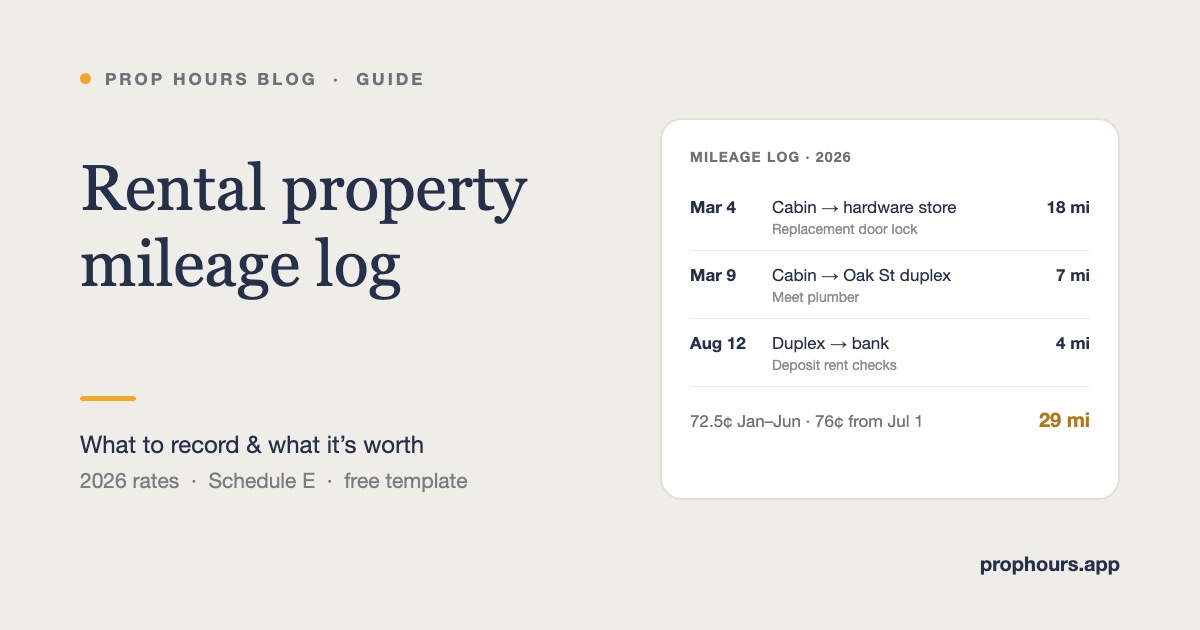
In short: driving you do to collect rent or to manage, conserve or maintain a rental can be deducted on Schedule E, line 6, either at the IRS standard mileage rate — 72.5 cents a mile for January through June 2026 and 76 cents from July 1, 2026 — or as actual car expenses. To claim it, keep a written log made at or near the time of each trip: the date, where you went, why, and the miles, plus your total miles for the year. Trips between your home and a rental are generally commuting, not rental mileage, unless your home is your principal place of business.
Download the mileage log template
Free, no sign-up. The workbook fills in the standard mileage rate for each trip date, totals miles by property and flags trips written down more than seven days after the drive.
Mileage is one of the easiest rental deductions to lose. The trips are short — a run for a replacement part, a key handoff, a check after a storm — and they happen between other things, so few owners write them down. By tax time the only evidence is a guess. Here is what the IRS asks you to record, which trips qualify, what they are worth at 2026 rates and where they go on your return.
Which trips count as rental mileage
IRS Publication 527 lets you deduct ordinary and necessary local transportation expenses you incur to collect rental income or to manage, conserve or maintain your rental property. Two questions decide whether a trip fits: why you made it, and where it started.
The purpose. Trips made for the rental itself qualify on this count: picking up repair parts or supplies, meeting a contractor, inspector or appraiser, showing a vacant unit, restocking between guests, checking the property after a storm, or depositing rent. Personal errands don’t become rental trips because you drove past the property.
The starting point. Publication 527 says transportation between your home and a rental property generally is nondeductible commuting, unless you use your home as your principal place of business. So the drive from your house to the cabin and back usually doesn’t count, even when the purpose is a repair. Legs that start at a rental are different: under the general transportation rules in Publication 463, getting from one work location to another is deductible, so a trip from the cabin to the hardware store and back, or from one of your rentals to another, is the kind of mileage the deduction is built for. If you run the rental business from a home office, ask your tax professional whether it qualifies as your principal place of business, because that changes how trips from home are treated.
What a mileage log has to show
Publication 463 (chapter 5, Table 5-1) lists what to prove for business use of a car: the mileage for each business use and your total miles for the year, the date of each use, and its business purpose. Most logs also record the starting point and destination — the route is usually what makes the purpose believable, and it is how you show a trip didn’t begin at home.
Timing matters as much as content. The IRS says to record the elements of a business use at or near the time of the use, and that a timely kept record has more value than a statement prepared later. A log on paper, in a spreadsheet or in an app all count; a record prepared on a computer is considered an adequate record. What doesn’t hold up well is a year of trips rebuilt from memory in March.
| Date | From → to | Business purpose | Miles |
|---|---|---|---|
| Mar 4, 2026 | Lake Cabin → hardware store → Lake Cabin | Replacement door lock | 18 |
| Mar 9, 2026 | Lake Cabin → Oak Street duplex | Meet plumber about a leaking supply line | 7 |
| Aug 12, 2026 | Oak Street duplex → bank | Deposit tenant rent checks | 4 |
| Year | Odometer Jan 1: 41,250 · Dec 31: 52,980 · total miles 11,730 | ||
The odometer readings give you total miles for the year, which you need either way: actual-expense claims are split by your rental share of total miles, and Form 4562 asks for both figures. If you depreciate the car, Publication 463 says to keep business-use records for each year of the recovery period.
Standard mileage rate or actual expenses
You can usually deduct either a flat rate per mile or the rental share of what the car actually cost to run. The standard rate is simpler and only needs the mileage log. The IRS raised the 2026 rate partway through the year, so the rate depends on the date of the trip:
| Trip dates | Business standard mileage rate |
|---|---|
| 2024 | 67 cents a mile |
| 2025 | 70 cents a mile |
| Jan 1 – Jun 30, 2026 | 72.5 cents a mile |
| Jul 1 – Dec 31, 2026 | 76 cents a mile (raised by IRS Announcement 2026-11) |
Example: the 18-mile hardware run on March 4 is worth 18 × $0.725 = $13.05 at the standard rate; the same trip on August 12 would be 18 × $0.76 = $13.68. An owner who logs 300 rental miles in each half of 2026 has 300 × $0.725 + 300 × $0.76 = $217.50 + $228.00 = $445.50, plus any business parking fees and tolls, which are deductible on top of the standard rate.
The standard rate comes with conditions. For a car you own, you must use it in the first year the car is available for use in your business; for a leased car, you must use it for the entire lease. You can’t use it if you operate five or more vehicles at the same time. And with the standard rate you can’t also deduct depreciation, lease payments or actual operating costs for that car. Actual expenses — gas, oil, repairs, insurance, tires, registration and depreciation — are deducted in proportion to your rental share of total miles, so the log matters there too.
Where mileage goes on your return
Rental mileage is reported on Schedule E, line 6, “Auto and travel,” in the column for the property the trip served. The Schedule E instructions say to include your standard-rate amount and your parking fees and tolls on that line, and that if you claim any auto expenses, actual or standard mileage, you must complete Part V of Form 4562 and attach it to your return. When one trip serves two properties, split the miles between them in a reasonable way and note how in the log.
Miles are not hours
If you are tracking material participation for the short-term rental loophole or real estate professional status, keep the two records apart in your head. A mileage log supports an expense deduction; an hour log supports participation. Writing down 18 miles adds nothing to your hours, and the hours you log should be the time you actually spent on the work. Whether drive time itself counts as participation is unsettled: some Tax Court cases treated driving between home and the property as commuting, while others counted travel to the rentals. A cautious approach is to log drive time on its own lines and check whether your test passes without it; our guide to how CPAs verify participation hours walks through those cases, and proving material participation covers what a complete hour record looks like.
Keeping the log without a separate habit
The trips worth logging are usually tied to work you are already recording: the lock you replaced, the plumber you met, the turnover you restocked. Writing the miles down the same day, next to that work, keeps the date, purpose and property consistent and saves rebuilding a second record at year end. The template above gives each trip its own row, with the property and purpose beside the miles.
What should a rental property mileage log include?
For each trip: the date, the miles driven, the business purpose and, in practice, where you started and where you went. You also need your total miles for the year, which odometer readings on January 1 and December 31 give you. Record each trip at or near the time you make it.
Can I deduct mileage from my home to my rental property?
Generally not. IRS Publication 527 treats travel between your home and a rental property as nondeductible commuting unless you use your home as your principal place of business. Trips that start at a rental, such as from the property to a supplier and back, are treated differently.
What is the 2026 standard mileage rate for rental property?
72.5 cents a mile for trips from January 1 through June 30, 2026, and 76 cents a mile from July 1 through December 31, 2026, after the IRS raised the rate midyear. The 2025 rate was 70 cents.
Where do I report rental property mileage?
On Schedule E, line 6, Auto and travel, for the property the trips served. If you claim any auto expenses, you must also complete Part V of Form 4562 and attach it to your return.
Can I deduct parking and tolls on top of the standard mileage rate?
Yes. Business-related parking fees and tolls can be deducted in addition to the standard mileage rate, and they go on the same line of Schedule E.
Related reading
See the rest of what landlords can deduct in Rental Property Tax Deductions and the Airbnb tax deductions checklist, and pair this log with the free material participation log template for your hours.
This article explains general federal rules as of October 2026 and is not tax advice. The examples are illustrative, and results depend on your facts, vehicle history, state rules and records. Review IRS Publication 527, Publication 463 and the standard mileage rates, and consult a qualified tax professional. PropHours records the work and trips you log; it does not determine what you can deduct.