
PROP HOURS BLOG
Short-Term Rental Tax Loophole Income Limit: Is There One?
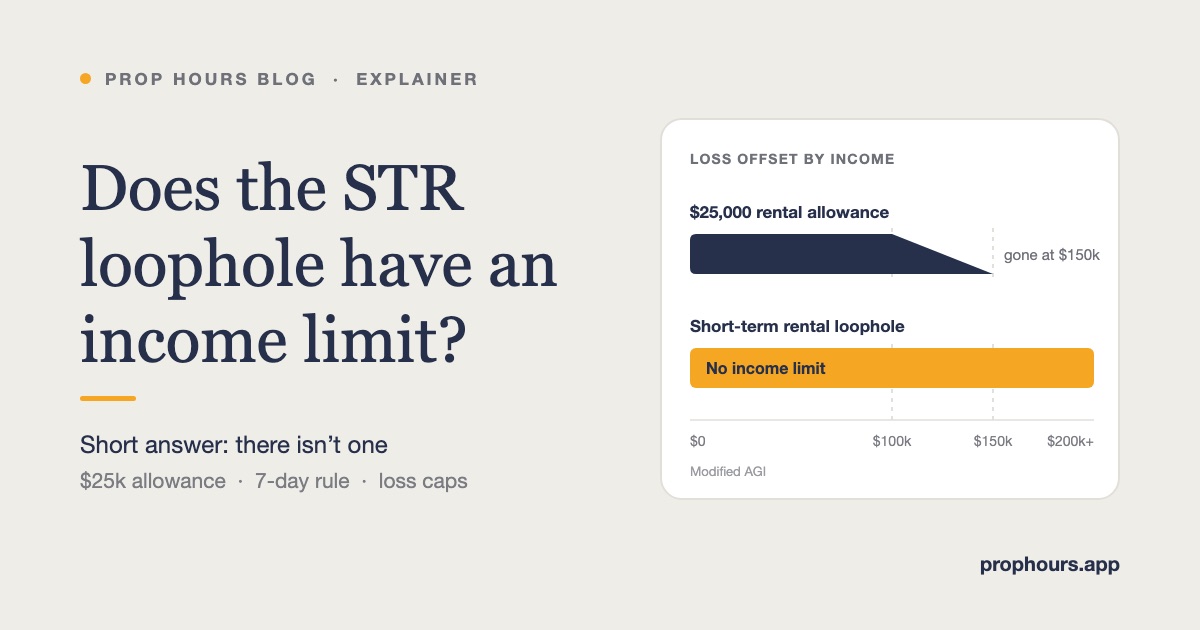
In short: no. The short-term rental tax loophole has no income limit. If your rental’s average guest stay is seven days or less and you materially participate, its losses are generally non-passive and can offset wages and other income, whether you earn $90,000 or $900,000. The $100,000–$150,000 phase-out people quote belongs to a different rule: the $25,000 allowance for ordinary rentals. What does limit a short-term rental loss is the seven-day average, your hours, personal use and two loss caps that matter mostly at high incomes.
If you have been told you “make too much” to deduct rental losses, that advice was probably right — for a long-term rental. It gets repeated about Airbnbs too, and that is where it goes wrong. Here is where the income limit really lives, why short-term rentals sit outside it, and the limits that do apply.
Where the “$150,000 limit” comes from
Under the passive activity rules, a rental is passive by default, and passive losses can only offset passive income. Ordinary landlords get one exception: if you actively participate — approving tenants, setting the rent, signing off on repairs — you can deduct up to $25,000 of rental real estate losses against your other income.
That allowance is the one with an income limit. It shrinks by 50 cents for every dollar of modified adjusted gross income above $100,000 and is gone at $150,000. If you are married filing separately and lived apart all year, the allowance is $12,500 and phases out between $50,000 and $75,000. Above the phase-out, a long-term rental’s losses are suspended — carried forward until you have passive income or sell — unless you qualify as a real estate professional. That is the income limit people remember.
Why it doesn’t apply to short-term rentals
When the average guest stay is seven days or less, the property isn’t a “rental activity” under the passive loss rules at all. It is treated like other business activities: passive only if you don’t materially participate. The material participation tests look at your hours and, for some tests, other people’s hours. None of them asks what you earn.
| Rule | Income limit | What you need | Who it fits |
|---|---|---|---|
| $25,000 rental allowance | Phases out between $100,000 and $150,000 of modified AGI | Active participation | Long-term landlords |
| Short-term rental loophole | None | Average stay of 7 days or less, plus material participation | Airbnb and Vrbo hosts |
| Real estate professional status | None | More than 750 hours and more than half your working time in real estate businesses, plus material participation | Full-time investors and agents |
Our short-term rental tax loophole guide explains how to calculate the average stay and how the rule works.
The flip side: the $25,000 allowance won’t rescue a short-term rental
The same rule cuts the other way. Because a rental with a seven-day average stay isn’t a rental activity, the $25,000 allowance generally isn’t available for it, even if your income is well under $100,000. If you don’t materially participate, its losses are simply passive and wait for passive income or a sale. For a short-term rental, income isn’t the question in either direction. Your hours are.
What actually limits a short-term rental loss
- The seven-day average. Total days rented divided by the number of stays, for the whole year. A few monthly bookings can push a property over the line, and the test is applied year by year, so a rental can qualify one year and not the next.
- Material participation. Most owners aim for the 100-hour test — more than 100 hours and at least as much as any other individual, including your cleaner — or the 500-hour test. Your spouse’s hours count toward material participation.
- Personal use. If you use the home yourself for more than the greater of 14 days or 10% of the days it is rented at a fair price, it is treated as a residence, and deductions are generally limited to the rental income. There is no loss left to deduct.
- Basis and at-risk limits. A loss can’t exceed your basis or the amount you have at risk in the property. Ordinary mortgage financing generally counts toward both, so this is rarely the binding limit, but unusual financing is worth checking with your CPA.
- The excess business loss limitation. This is where high income comes in — as a cap on the loss, not a limit on who qualifies. For 2026, net business losses above $256,000 ($512,000 on a joint return) can’t offset wages and other nonbusiness income that year; the excess carries forward as a net operating loss. The 2026 figure is lower than 2025’s $313,000 ($626,000) because the One Big Beautiful Bill Act reset how the threshold is indexed.
For example, a married couple with $700,000 of wages and a $600,000 first-year loss on a large short-term rental could use $512,000 of the loss against their wages in 2026, assuming no other business income or losses. The remaining $88,000 would carry forward to later years.
Higher income makes the loophole worth more
A deduction is worth your marginal rate, so the strategy pays more as income rises. A $100,000 loss saves roughly $24,000 of federal tax in the 24% bracket, $32,000 at 32% and $37,000 at 37%, before state tax. Two caveats keep this honest. Much of a first-year loss comes from accelerated depreciation, which is a timing benefit that can come back as depreciation recapture when you sell. And every dollar depends on the hours behind it. Try your own numbers in the STR loophole tax savings calculator.
Protect the claim with records
Since your income doesn’t decide the outcome, your records do. Keep a booking export that shows the average stay, and log your hours the day you work them: date, property, task, minutes, and the message or receipt behind it. If you are aiming for the 100-hour test, track your cleaner’s and co-host’s time too. Our guide on how to prove material participation shows what a strong record looks like, and the PropHours app logs by timer, voice or receipt scan and can import booking calendars from Airbnb, Vrbo and Hospitable.
Is there an income limit for the short-term rental tax loophole?
No. If the average guest stay is seven days or less and you materially participate, the rental's losses are generally non-passive at any income level. The $100,000 to $150,000 phase-out applies to the $25,000 allowance for ordinary rentals, not to short-term rentals.
Does the $25,000 rental loss allowance apply to Airbnb rentals?
Generally not when the average stay is seven days or less, because the property isn't a rental activity under the passive loss rules. Those owners need material participation instead, and income doesn't change that either way.
Can I use the STR loophole if I earn more than $500,000?
Yes. There's no income cap, but the excess business loss limitation can delay part of a large loss: for 2026, net business losses above $256,000 ($512,000 on a joint return) can't offset wages and other nonbusiness income that year, and the rest carries forward as a net operating loss.
Does real estate professional status have an income limit?
No. REPS is an hours test: more than 750 hours and more than half of your working time in real property trades or businesses, plus material participation in the rentals. Income doesn't factor in, but a full-time job usually makes the more-than-half test impossible.
Related reading
Start with the short-term rental tax loophole guide, see how the strategy fits a day job in The STR Loophole for W-2 Employees, and learn what a strong log looks like in How to Prove Material Participation.
This article explains general federal rules as of October 2026 and is not tax advice. The examples are illustrative, and results depend on your income, elections, state rules and records. Review IRS Publication 925 and consult a qualified tax professional. PropHours records the work you log; it does not determine tax eligibility.