
PROP HOURS BLOG
The STR Loophole for W-2 Employees: A Practical Playbook
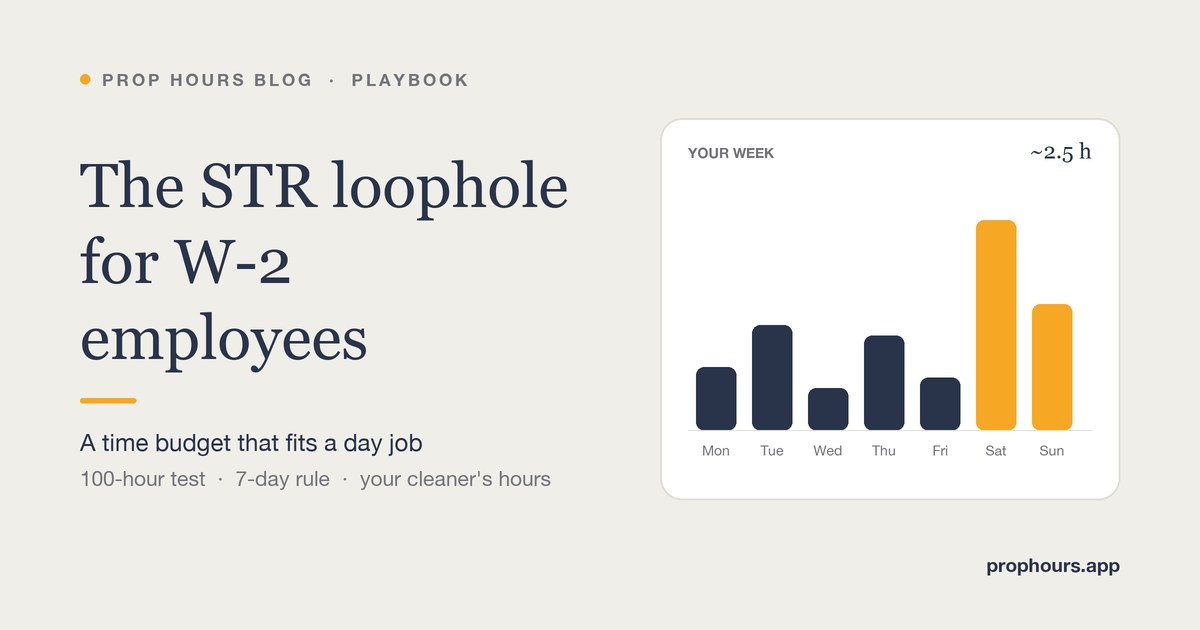
In short: yes, W-2 employees can use the short-term rental loophole, and it is the route that actually fits a full-time job. You don’t need real estate professional status. You need two things for the year: an average guest stay of seven days or less, and material participation in the rental — for most employees, the 100-hour test. That works out to roughly two and a half hours a week, as long as nobody else, including your cleaner, puts in more time than you.
Most W-2 earners hear about this strategy the same way: a colleague bought a cabin, ran it themselves on evenings and weekends, and cut their tax bill. The part that gets skipped is how they did it with a day job — which test they aimed for, how they kept the cleaner’s hours below theirs, and how they logged the work without it becoming a second job. This is that part.
Why REPS is out of reach, and why you don’t need it
Real estate professional status requires more than 750 hours in real property trades or businesses and more than half of all your working time. Your job hours count toward the total but not toward the real-estate side, unless you own more than 5% of your employer. With a 2,000-hour job, you would need more than 2,000 real-property hours in the same year. For almost every full-time employee, that is the end of the REPS route.
The short-term rental route sidesteps it. When the average guest stay is seven days or less, the property isn’t a “rental activity” under the passive-loss rules, so it isn’t passive by default. Materially participate, and its losses are generally non-passive and can offset your wages. Our STR loophole guide covers the rule itself, including how to calculate your average stay.
Pick the test that fits a day job
- The 100-hour test: more than 100 hours in the year and at least as much as any other individual. The realistic target for most employees.
- The 500-hour test: more than 500 hours, with no comparison. About ten hours a week — hard alone, more realistic with a spouse, because your spouse’s hours count toward material participation.
- The substantially-all test: your work is substantially all of the work on the property. Only fits owners who do nearly everything themselves, turnovers included.
See the 100-hour test guide and the 500-hour test guide for the details.
The weekly time budget
Hours only start counting once the rental is placed in service, so the date you open matters as much as the target. Aim above the line — around 130 hours for the 100-hour test — so a few disputed entries don’t sink you.
| Goal | Open for | Hours per week |
|---|---|---|
| 100-hour test, 130-hour target | Full year (52 weeks) | 2.5 |
| 100-hour test, 130-hour target | From July 1 (26 weeks) | 5 |
| 100-hour test, 130-hour target | From October 1 (13 weeks) | 10 |
| 500-hour test, 520-hour target | Full year (52 weeks) | 10 |
A late-year purchase is where many W-2 plans break: bonus depreciation doesn’t shrink because you opened in October, but your time to earn the hours does. If you’re buying in the fall, plan the first-year hours before you close.
Your cleaner is the real competition
The 100-hour test compares you with every other individual who works on the property — cleaner, co-host, handyman, property manager. For a busy short-term rental, the cleaner is usually the one to beat: three turnovers a week at two hours each is about 312 hours a year.
The comparison is person by person, not company by company. Several cleaners who each work fewer hours than you don’t defeat the test; one cleaner who works more than you does. That leaves three honest options: keep the busiest individual’s hours below yours, take on more of the operational work yourself, or aim for the 500-hour test, which has no comparison at all. Our article on the 100-hour trap walks through each.
What a W-2 week actually looks like
The work that counts is the work an owner customarily does to run the rental, and much of it fits around a job:
- Weeknights: guest messages, reviews, pricing changes, cleaner scheduling, bookkeeping.
- Weekends: restocking, inspections, minor repairs, meeting contractors, a turnover of your own when the calendar allows.
- Doesn’t count: investor-type work such as studying market reports or reviewing statements in a non-managerial role.
Log it the same day: property, task, actual minutes, and the message thread or receipt behind it. A timer or a quick voice note takes seconds; a weekend of reconstruction in April is the kind of record that fails. Our free log template has a tab for your cleaner’s hours, and the PropHours app logs by timer, voice or receipt scan.
What the numbers can look like
Take an illustrative case: Sam earns $280,000 at a tech job and places a $600,000 cabin in service in March 2026. With a cost segregation study and 100% bonus depreciation on the short-life components and furniture, the first year shows a loss of about $120,000. If the average stay is under seven days and Sam materially participates, that loss generally reduces taxable income; at a 32% to 35% marginal rate, that is roughly $38,000 to $42,000 of federal tax.
Two caveats keep this honest. The at-risk rules and the excess business loss limitation can cap how much offsets wages in one year. And depreciation is a timing benefit: much of it comes back as depreciation recapture when you sell. Model both with your CPA, and try your own numbers in the STR loophole tax savings calculator.
Withholding, audits and the failure points
Your employer keeps withholding as if nothing changed; the loss shows up when you file. If you are confident in the numbers, you can reduce withholding by entering the expected deduction on Form W-4 — but if the strategy fails, you owe the difference, so many owners wait until the year’s hours are in the log.
When these claims fail, it is usually for one of four reasons: a manager or cleaner out-worked the owner, the log was reconstructed after the fact, the average stay crept past seven days, or personal use muddied the picture. Every one of them is visible in the records, which is why the records are the strategy.
Can W-2 employees use the STR loophole?
Yes. If the rental's average guest stay is seven days or less and you materially participate, its losses are generally non-passive and can offset wages, subject to the at-risk rules and the excess business loss limitation. You don't need real estate professional status.
Do I need real estate professional status?
No. REPS requires more than half of your working time in real estate, which a full-time job almost always rules out. The short-term rental route doesn't depend on REPS; it depends on the seven-day average stay and material participation.
How many hours a week do I need?
For the 100-hour test over a full year, about two hours a week; aiming for 130 hours means about two and a half. If the rental opens mid-year, the same hours fit into fewer weeks, so the weekly load rises. You also need at least as many hours as any other individual who works on the property.
Does my spouse's time count?
Yes, for material participation. Your spouse's work on the rental generally counts with yours, even if your spouse doesn't own it, which can make the 500-hour test realistic for a couple.
Will the loss lower my paycheck withholding automatically?
No. Your employer withholds based on your Form W-4, and the loss shows up when you file your return. You can adjust your W-4 if you're confident in the numbers, but if the strategy fails you will owe the difference.
Related reading
Start with the short-term rental tax loophole guide, see how furniture and setup costs are handled in Are Airbnb Startup Costs Tax Deductible?, and compare hour-tracking tools in PropHours vs REPSLog.
This article explains general federal rules as of September 2026 and is not tax advice. The example is illustrative, and results depend on your income, elections, state rules and records. Review IRS Publication 925 and consult a qualified tax professional. PropHours records the work you log; it does not determine tax eligibility.