
PROP HOURS BLOG
Do Spouse Hours Count for REPS and STR Material Participation?
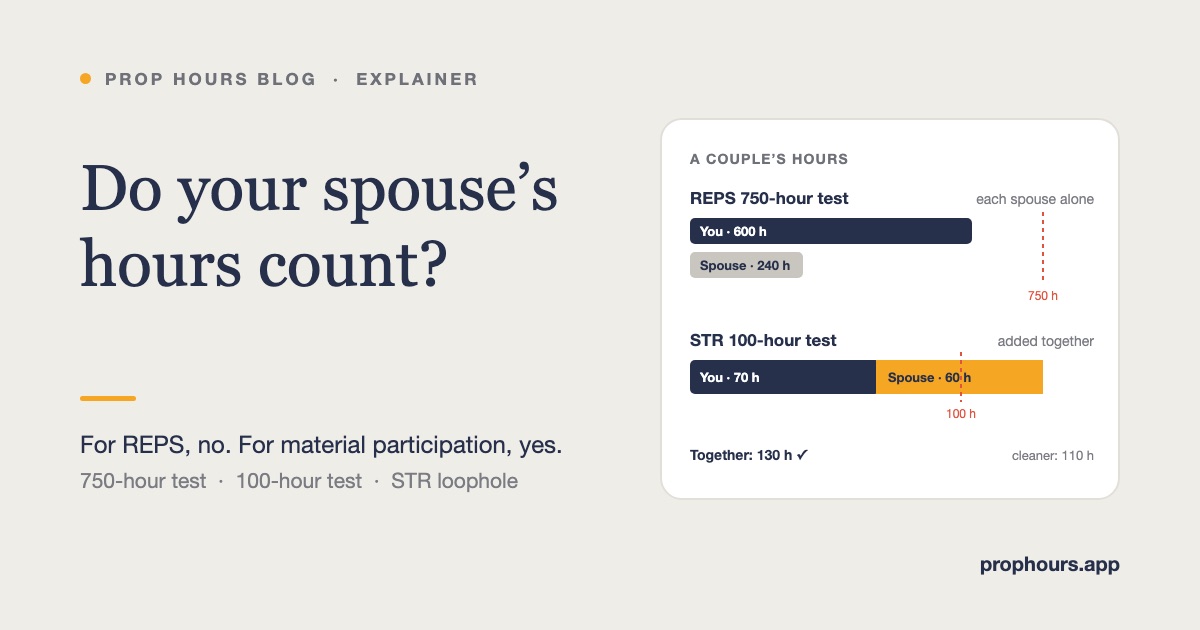
In short: it depends on which test. For real estate professional status, no: one spouse has to clear the 750-hour test and the more-than-half test alone. For material participation — including the 100-hour and 500-hour tests behind the short-term rental loophole — yes: your spouse’s work on the property counts as yours, even if your spouse isn’t on the title. Mixing up those two rules is one of the most common ways a married couple’s claim falls apart.
Married investors usually run rentals as a team: one spouse handles guests and pricing, the other meets contractors on Saturdays. The tax rules treat that teamwork differently depending on what you are trying to prove. Here is the rule for each test, two worked examples and how to keep records that hold up.
The rule, test by test
| Test | Spouse’s hours count? | What that means |
|---|---|---|
| REPS: more than 750 hours | No | One spouse must log more than 750 hours in real property trades or businesses on their own. |
| REPS: more than half your working time | No | Measured against the qualifying spouse’s own working time. The other spouse’s job doesn’t enter the math. |
| Material participation (all seven tests) | Yes | Your spouse’s work on the activity is treated as yours, whether or not your spouse owns it. |
| STR loophole: 100-hour test | Yes | The couple’s combined hours must exceed 100 and be at least as much as any other individual’s. |
| STR loophole: 500-hour test | Yes | The couple’s combined hours must exceed 500. |
| $25,000 allowance: active participation | Yes | Either spouse’s management decisions can satisfy it. |
The statute draws the line itself. For REPS, the requirements are met on a joint return only if either spouse separately satisfies them. For material participation, Treasury regulations say a spouse’s participation counts as the taxpayer’s, even if the spouse owns no interest and even if you file separately.
REPS: one spouse has to qualify alone
Real estate professional status is a test of a person, not a household. The qualifying spouse needs more than 750 hours in real property trades or businesses and more than half of their own working time in those businesses. Hours the other spouse puts into the rentals don’t move either number.
That cuts both ways. Your spouse’s 300 hours can’t push you from 600 to 900. But your spouse’s 2,000-hour job also doesn’t count against you: the more-than-half test looks only at the qualifying spouse’s own working time. That is why the classic setup is one spouse running the rentals full time while the other keeps a salaried job.
Example: Chris manages the couple’s six long-term rentals full time and logs 1,100 hours. Dana is a nurse working 2,000 hours a year and helps with about 300 hours of rental work. Chris qualifies as a real estate professional; Dana doesn’t, and doesn’t need to. Dana’s hospital hours never touch Chris’s more-than-half test.
Material participation: the couple counts as one
Qualifying for REPS is only the first gate. The rentals still have to pass a material participation test before their losses become non-passive — and here the rule flips. The couple’s hours are added together.
In the example above, Chris’s 1,100 hours and Dana’s 300 hours both count toward material participation in the rentals. If Chris elects to treat all six rentals as one activity, the combined 1,400 hours clear the 500-hour test easily, and on a joint return the losses can generally offset Dana’s wages. Our REPS guide covers the grouping election and the rest of the rule.
Ownership doesn’t matter for this part. A spouse who isn’t on the deed or the LLC still adds hours, as long as the work is the kind an owner customarily does — not investor-type work such as reviewing statements or reading market reports.
The short-term rental loophole: why couples have an edge
The short-term rental loophole doesn’t need REPS at all, only material participation. So for a short-term rental, a married couple’s hours combine from the start.
Example: Priya works full time and logs 70 hours on the couple’s cabin over the year, mostly guest messages and pricing. Marcus logs 60 hours of restocking, repairs and two turnovers. Their cleaner works 110 hours. Neither spouse passes the 100-hour test alone, and either one would lose the comparison with the cleaner. Together they have 130 hours, more than 100 and more than the cleaner, so the test is met.
The same math makes the 500-hour test realistic for a couple: about five hours a week each over a full year. And the 500-hour test has no comparison with anyone else, so a busy cleaner stops mattering.
Who doesn’t count as a spouse
The attribution rule is for spouses only. An unmarried partner, a parent, an adult child or a friend who co-hosts doesn’t add hours to yours, even if they live with you. Worse, under the 100-hour test each of them is “any other individual” you have to match or beat. If a family member does much of the work, have the family member log it anyway: you need their hours either to show the work wasn’t yours or to show yours was more.
How to log a couple’s hours
- One person per entry. Record who did the work, not “we.” For REPS, whose hours are whose is the whole analysis, and the same log has to serve both tests.
- Don’t double up shared time. If you both spend two hours meeting a contractor, the conservative approach is to log what each of you actually did and ask your CPA before counting joint time twice.
- Track the REPS spouse’s other work. The more-than-half test needs every hour of that spouse’s working time, real estate or not.
- Keep the evidence with the entry. Date, property, task, minutes and the message or receipt behind it, logged the day it happened.
In the PropHours app you can invite your spouse as a participant, so each of you logs your own time on the same property under your own name. Our guide to proving material participation shows what a complete record looks like.
Can my spouse's hours count toward my 750 hours for REPS?
No. On a joint return, real estate professional status applies only if one spouse separately meets both the 750-hour test and the more-than-half test. Your spouse's rental work can't be added to your hours for either one.
Does my spouse need to own the property for their hours to count?
No. For material participation, your spouse's work on the activity counts as yours even if your spouse owns no interest in it and even if you file separate returns.
Can a married couple combine hours for the STR 100-hour test?
Yes. The couple's hours are added together, and the combined total must exceed 100 hours and be at least as much as any other individual's, such as your cleaner or co-host.
If my spouse qualifies for REPS, can our rental losses offset my W-2 income?
Generally yes on a joint return, as long as the rentals also pass a material participation test. For that test, both spouses' hours count, even though only the qualifying spouse's hours count toward REPS itself.
Related reading
Start with the real estate professional status guide, see how a couple with day jobs can budget hours in The STR Loophole for W-2 Employees, and check whether income matters in Short-Term Rental Tax Loophole Income Limit: Is There One?
This article explains general federal rules as of October 2026 and is not tax advice. The examples are illustrative, and results depend on your facts, elections, state rules and records. Review IRS Publication 925 and consult a qualified tax professional. PropHours records the work you log; it does not determine tax eligibility.