
PROP HOURS BLOG
Airbnb Schedule E vs. Schedule C for Short-Term Rentals
Report Airbnb rental income and expenses on Schedule E (Form 1040) when you rent out real estate and provide only ordinary rental services. If you provide substantial services mainly for your guests’ convenience, such as daily housekeeping during their stay, you generally use Schedule C. An average stay of seven days or less affects how the passive activity rules apply. The services you provide determine which schedule you generally use. This guide covers U.S. federal reporting for individuals who rent out property they own. IRS Schedule E instructions · IRS Publication 925
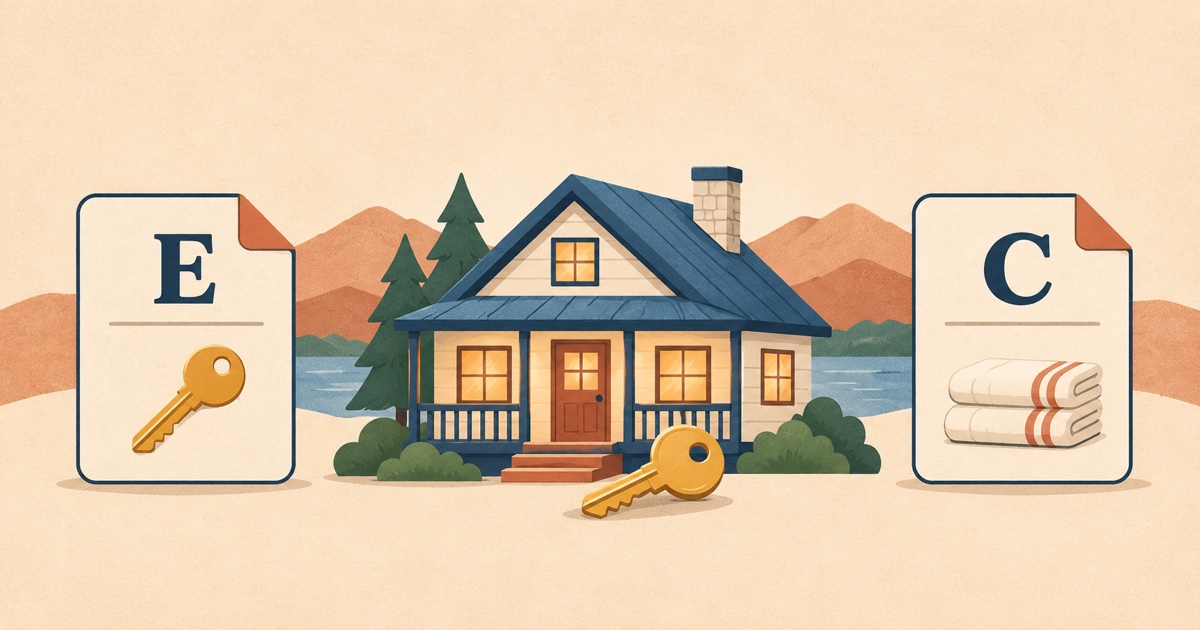
When do Airbnb hosts use Schedule E or Schedule C?
Schedule E, Part I generally applies when guests pay for the use of the property and you provide ordinary rental services. Utilities, trash collection and cleaning common areas are examples. A furnished cabin with a self-check-in code and cleaning between reservations typically fits this pattern. IRS Publication 527, chapter 3
Schedule C generally applies when substantial services are part of the stay and primarily serve the guest’s convenience. Daily room cleaning and regular linen changes during an occupied stay are examples. If you hire staff to deliver guest services, include those services when you describe the operation to your preparer. Net income from an operation that provides substantial guest services may also be subject to self-employment tax, reported on Schedule SE. IRS Publication 527, chapter 3 · IRS Chief Counsel Advice 202151005, illustrative fact patterns
Two Airbnb rentals with the same three-night average
In each example, an individual owns one property, operates it as a trade or business and meets a material participation test. Guests stay three nights on average.
| What to compare | Self-check-in cabin | Serviced guest suite |
|---|---|---|
| Guest services | Utilities and cleaning between reservations | Daily room cleaning and fresh linens during each stay |
| Usual reporting | Schedule E, Part I | Schedule C |
| Passive activity treatment | Generally nonpassive | Generally nonpassive |
If your cleaner works both between reservations and during stays, pull the invoices and note when the work happened, what guests received and how often. The cleaning fee on a booking statement tells your CPA how much was charged. The listing and service records show what the guest actually received.
How the 7-day rule affects Airbnb losses
When the average period of customer use is seven days or less, the activity falls outside the definition of a rental activity under the federal passive activity rules. If the short-term rental is a trade or business and you materially participate, its current-year result is generally nonpassive. If you fall short of material participation, a loss may be limited and carried forward. Other limits can still affect how much of a nonpassive loss you can deduct. IRS Publication 925 · IRS Form 8582 instructions
Use your reservations to check the average with the 7-day rule calculator. Then use the short-term rental material participation guide to see which test your records support. If you have a passive loss or a carryover from a previous year, see how Form 8582 handles rental losses.
What Airbnb hosts should send their CPA
- Bookings and use. Export reservation dates from Airbnb and any other booking channels, including direct bookings. Flag owner or family use on the calendar.
- Guest services. Send the listing, service agreement and sample invoices. Mark which tasks take place during an occupied stay and how often guests receive them.
- Income and expenses. Include payout reports, any Form 1099-K, direct payments and receipts. Reconcile gross payments to bank deposits, documenting platform fees and refunds. Use the Airbnb tax deductions checklist to organize expenses.
- Participation and prior filings. Include your dated work log, supporting records and any prior Form 8582 carryovers. If you rely on the 100-hour test, include the hours of anyone else who worked on the activity so your CPA can compare your time with each individual’s. Start with the free material participation log template.
PropHours lets you share dated activity records and evidence with your CPA. Keep the reservation and service records alongside your log so your preparer has what they need for both decisions.
Frequently asked questions
Does a Form 1099-K mean my Airbnb goes on Schedule C?
Form 1099-K reports gross payments processed by the platform. Airbnb income can go on Schedule E or Schedule C depending on the operation and the services you provide. Reconcile the form to your records and include reportable income from direct bookings. IRS Form 1099-K guidance
Can an Airbnb reported on Schedule E have a nonpassive loss?
Yes. A short-term rental reported on Schedule E can have a nonpassive loss if it qualifies for a rental activity exception under Section 469 and you materially participate in the trade or business. The amount you can deduct is subject to other applicable loss limits. IRS Form 8582 instructions
Can the same host use Schedule E for one property and Schedule C for another?
Yes. For example, an owner can rent out a self-service cabin and operate a separate guesthouse that offers daily housekeeping and linen service. Give your CPA separate records for each operation, including which services are included with each stay. IRS Publication 527
This guide covers general U.S. federal rules. Your preparer can confirm how they apply to your ownership structure, guest services and records.