
PROP HOURS BLOG
Form 8582 for Rental Owners: Passive Loss Limits and Carryovers
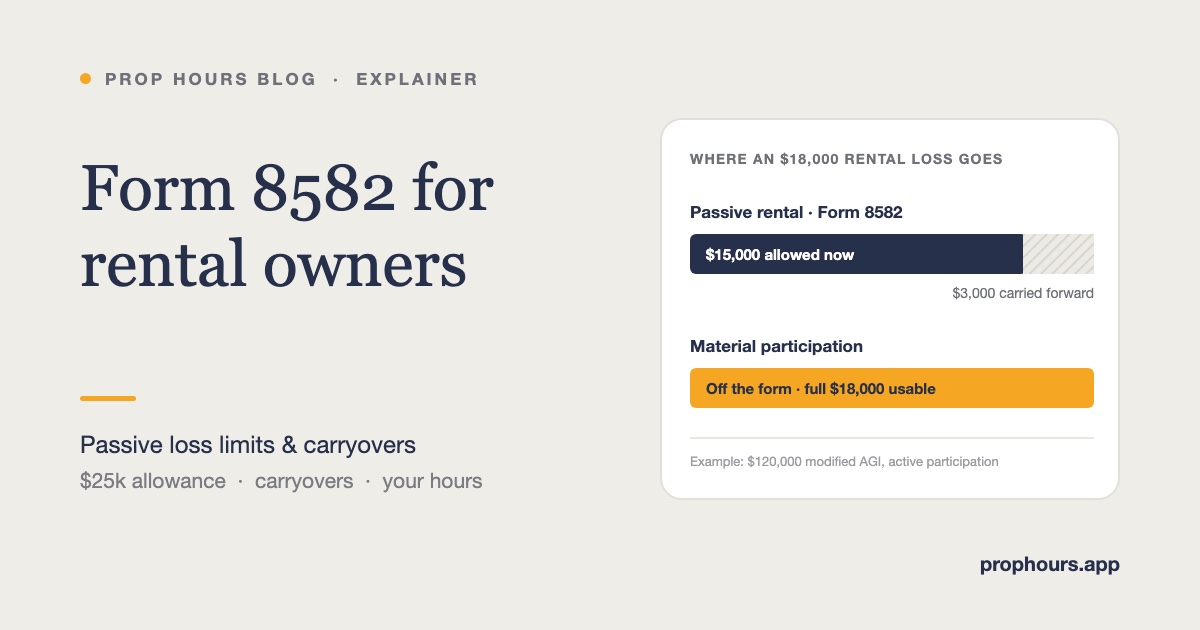
In short: Form 8582, Passive Activity Loss Limitations, is where the IRS caps losses from passive activities — including most rentals — and keeps track of the losses you couldn’t use. If your rental is passive, its loss runs through this form before it reaches your return, and whatever isn’t allowed carries forward. If you materially participate as a real estate professional, or in a short-term rental with an average stay of seven days or less, the rental isn’t passive and stays off the form. Your hours decide which side you’re on.
Rental owners usually meet Form 8582 the same way: the software produces it, the loss on Schedule E is smaller than expected, and a “prior year unallowed loss” appears with no explanation. This guide walks through what the form does, who has to file it, how the 2025 form works line by line, how passive loss carryovers are released, and how material participation takes a rental off the form entirely.
What Form 8582 does
Section 469 of the tax code says losses from passive activities can generally offset only passive income. Form 8582 applies that rule. It adds up your passive activities for the year, works out how much of the combined loss you can deduct now, and allocates the rest to each activity as an unallowed loss that carries forward to the next year.
Individuals, estates and trusts file it with Form 1040, 1040-SR or 1041. The form doesn’t replace Schedule E: once it decides how much loss is allowed, you report that amount on the forms and schedules you normally use, which for most rentals is Schedule E.
A rental is passive by default, whether or not you work on it. Two exceptions matter most to owners, and both depend on material participation: real estate professional status, and the short-term rental rule. More on both below.
Who has to file Form 8582
You generally file Form 8582 if you have a loss from a passive activity this year, or a prior year’s unallowed passive loss. The instructions give one exception for small landlords. You don’t need the form if all of these are true:
- Your only passive activity is rental real estate in which you actively participated.
- You have no prior-year unallowed losses from any passive activity.
- Your total loss from those rental real estate activities is $25,000 or less ($12,500 if married filing separately).
- If you are married filing separately, you lived apart from your spouse all year.
- You have no current or prior-year unallowed credits from a passive activity.
- Your modified adjusted gross income is $100,000 or less ($50,000 if married filing separately).
- You don’t hold an interest in a rental real estate activity as a limited partner or as a beneficiary of an estate or trust.
Miss any one of them — most often the income test or a carryover from an earlier year — and the form is required. Active participation is a light standard: approving new tenants, deciding rental terms and approving repairs usually meet it. It is not the same as material participation.
Is your rental on Form 8582?
Where a rental lands depends on what kind of rental it is and on your participation, not on how much it lost.
| Your situation | Passive? | On Form 8582 | $25,000 allowance |
|---|---|---|---|
| Long-term rental, you actively participate | Yes | Part IV (lines 1a–1c) | Yes, phased out between $100,000 and $150,000 of modified AGI |
| Rental real estate without active participation, such as a limited partner’s share | Yes | Part V (lines 2a–2c) | No |
| Real estate professional who materially participates in the rental | No | Not on the form | Not needed |
| Real estate professional who doesn’t materially participate in that rental | Yes | Part IV if you actively participate | Yes, with the same phase-out |
| Short-term rental, average stay 7 days or less, you materially participate | No | Not on the form | Not needed |
| Short-term rental, average stay 7 days or less, no material participation | Yes | Part V, with other passive activities | No — it isn’t a rental activity |
The last row surprises people. A short-term rental that meets the seven-day rule isn’t a “rental activity” under the passive loss rules, so it can’t use the $25,000 allowance meant for rental real estate. It is either non-passive, because you materially participate, or an ordinary passive activity in Part V. Our STR loophole guide covers the seven-day rule, and this explainer covers why income doesn’t limit it.
Form 8582, line by line (2025 form)
The 2025 Form 8582 is the version filed in 2026. You fill in the activity worksheets in Parts IV and V first, then the totals in Parts I through III.
| Part | Lines | What it does |
|---|---|---|
| Part IV | Columns (a)–(e) | Lists each rental real estate activity with active participation: current-year net income (a), net loss (b), prior years’ unallowed loss (c), and overall gain (d) or loss (e) if you disposed of it. |
| Part V | Columns (a)–(e) | The same for every other passive activity, including a seven-day short-term rental you didn’t materially participate in. |
| Part I | 1a–3 | Totals from Parts IV and V. Line 3 combines lines 1d and 2d. If line 3 is zero or more, you stop: every loss is allowed, including prior-year carryovers. |
| Part II | 4–9 | The $25,000 special allowance. Line 4 is the smaller of the loss on line 1d or line 3. Line 5 is $150,000, line 6 your modified AGI, line 7 the difference, and line 8 is 50% of line 7, capped at $25,000. Line 9 is the smaller of lines 4 and 8. |
| Part III | 10–11 | Line 10 adds any passive income from lines 1a and 2a. Line 11, total losses allowed for 2025, is line 9 plus line 10. |
| Parts VI–IX | — | Spread the allowance and the unallowed loss across your activities. Part VII, column (c), is each activity’s unallowed loss — next year’s carryover. Part VIII shows the loss allowed for each activity. |
Two details trip people up. Line 6 is modified AGI: you figure it without passive activity losses, rental losses allowed to real estate professionals, taxable Social Security, the deductible part of self-employment tax, IRA and student loan interest deductions, and a few other items listed in the instructions. And if you are married filing separately and lived with your spouse at any point in the year, you skip Part II altogether — no allowance.
A worked example
Maya is single, earns a salary, and has modified AGI of $120,000. She owns one long-term rental, actively participates, and it shows a net loss of $18,000. She has no other passive activities and no carryovers. Because her income is over $100,000, she needs Form 8582.
- Part IV and Part I: $18,000 goes in column (b), so line 1b is ($18,000), line 1d is ($18,000), and line 3 is a loss of $18,000.
- Part II: line 4 is $18,000. Line 5 is $150,000, line 6 is $120,000, so line 7 is $30,000 and line 8 is $15,000. Line 9, the smaller of $18,000 and $15,000, is $15,000.
- Part III: line 10 is zero, so line 11 — the loss Maya can deduct this year — is $15,000.
- The carryover: the remaining $3,000 is her unallowed loss in Part VII, column (c). It goes on next year’s form in column (c) and line 1c.
Next year, with the same income and a $10,000 loss, line 1d becomes ($13,000) including the carryover. Her allowance is still $15,000, so all $13,000 is allowed and the old $3,000 is used up. Had her modified AGI been $150,000 or more, line 9 would have been zero and the whole $18,000 would have carried forward.
Now change one fact. If the same $18,000 loss came from a short-term rental with a 3.5-night average stay, and Maya logged 140 hours of work — more than her cleaner or anyone else — she would meet the 100-hour material participation test. The activity wouldn’t be passive, it wouldn’t appear on Form 8582, and the full loss could offset her salary, subject to the at-risk and excess business loss limits. Same loss, different form, because of the hours.
Passive loss carryovers: how suspended losses get used
An unallowed passive loss isn’t lost. It carries forward with the activity, year after year, until something releases it. Each year you copy the prior year’s unallowed losses from Part VII, column (c), of last year’s form into column (c) of Part IV or Part V. From there, a carryover is released in three ways:
- Passive income. When your passive activities show net income — line 3 is zero or more — carryovers are allowed up to that income. A profitable rental, or another passive investment, can absorb old losses.
- Room in the $25,000 allowance. For rentals with active participation, carryovers count toward line 1d, so they can be used whenever your income leaves room in the allowance, as in Maya’s second year.
- Selling the whole activity. When you dispose of your entire interest in a fully taxable transaction to an unrelated person, that activity’s suspended losses are generally allowed in full that year. Keep the history: the sale is also when depreciation recapture shows up.
Qualifying later doesn’t convert old losses. If an activity was passive in earlier years but isn’t now — you became a real estate professional and materially participate, say, or you started running your short-term rental yourself — the IRS calls it a former passive activity. Its old unallowed losses can offset income from that same activity, and they are still entered on Form 8582. They don’t become deductible against your salary just because this year’s losses are.
How material participation keeps a rental off Form 8582
There are two routes, and both run through the seven material participation tests:
- Real estate professional status. More than 750 hours, and more than half of your working time, in real property trades or businesses, plus material participation in the rental. Our REPS guide covers the requirements and tax benefits.
- The short-term rental rule. An average guest stay of seven days or less, plus material participation — usually the 100-hour or 500-hour test. No REPS needed.
Either way, the claim rests on hours. The Form 8582 instructions say you can prove participation by any reasonable means — contemporaneous daily logs aren’t strictly required — and give appointment books, calendars or narrative summaries that identify the services and approximate hours as examples. In practice, a log written as the work happens is far easier to defend than a summary rebuilt in April. See how to prove material participation for what a strong record looks like, or start with our free material participation log template.
That is the job PropHours does: log each task by timer, voice note or receipt scan as you work, tagged to the property, then hand your CPA a dated, per-property record. It is the same evidence a preparer looks for when verifying material participation hours before deciding whether a rental belongs on Form 8582.
Common Form 8582 mistakes rental owners make
- Claiming the $25,000 allowance for a short-term rental. A rental with a seven-day average stay isn’t a rental activity, so it doesn’t belong in Part IV.
- Dropping last year’s carryover. When you switch preparers or software, the prior year’s Part VII, column (c), often gets lost. Keep a copy of every Form 8582.
- Using AGI instead of modified AGI. Line 6 excludes passive losses and several other items, which can change your allowance.
- Treating REPS as automatic. Real estate professional status removes the automatic passive label, but a rental you don’t materially participate in is still passive and still on the form.
- Taking the allowance while married filing separately and living together. If you lived with your spouse at any time during the year, Part II doesn’t apply.
- Forgetting the release on a sale. A fully taxable sale of your entire interest to an unrelated buyer frees that activity’s suspended losses. Make sure they come off the form that year.
- Claiming material participation without records. Keeping a rental off Form 8582 is a claim about hours, so it needs hours on paper.
What is Form 8582 used for?
Form 8582, Passive Activity Loss Limitations, figures how much of your passive activity losses you can deduct this year and how much carries forward. Most rentals are passive, so rental owners with a loss often need it, especially with modified AGI above $100,000 or with losses carried over from earlier years.
Do I have to file Form 8582 for my rental property?
Not if all of the instructions’ conditions are met: your only passive activity is rental real estate you actively participate in, the total loss is $25,000 or less, modified AGI is $100,000 or less, and you have no prior-year unallowed losses or passive credits, among others. Otherwise, a passive rental loss generally requires the form.
Do passive loss carryovers expire?
No. Unallowed passive losses carry forward indefinitely with the activity. They are released against future passive income, through the $25,000 allowance when you have room, or in full when you sell your entire interest in a fully taxable transaction to an unrelated person.
Does the $25,000 allowance apply to short-term rentals?
Generally not when the average guest stay is seven days or less. That property isn’t a rental activity under the passive loss rules, so it is either non-passive because you materially participate, or an ordinary passive activity reported in Part V without the allowance.
Do real estate professionals file Form 8582?
Not for rentals they materially participate in, because those aren’t passive. A real estate professional still uses Form 8582 for rentals they don’t materially participate in, for other passive activities, and for old carryovers from years before they qualified.
Where do I find last year’s passive loss carryover?
On last year’s Form 8582, Part VII, column (c), which lists the unallowed loss for each activity. Enter it in column (c) of Part IV or Part V on this year’s form; the totals flow to line 1c or 2c.
Related reading
Start with what material participation means and the seven tests. Then compare the two ways out of the passive box: the STR loophole and real estate professional status. Long-term landlords should also read the rental property tax deductions guide, and couples can check whether spouse hours count.
This article explains the 2025 Form 8582 and general federal rules as of October 2026. It is not tax advice. The examples are illustrative, and results depend on your income, filing status, elections and records. Review the IRS Instructions for Form 8582 and Publication 925, and consult a qualified tax professional. PropHours records the work you log; it does not determine tax eligibility.