
PROP HOURS BLOG
Buying a Short-Term Rental in December: Can You Still Use the STR Loophole?
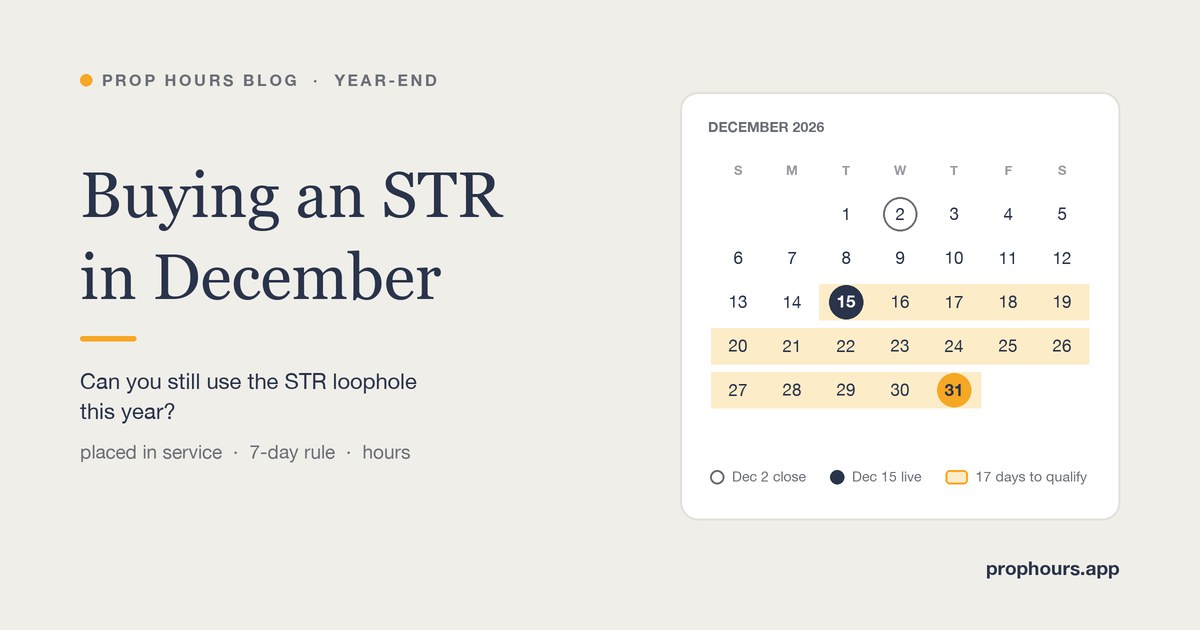
In short: yes, it can work, but December leaves very little room. Bonus depreciation isn’t prorated, so a cabin placed in service on December 15 can produce the same first-year deduction as one placed in service in March. The tests that decide whether that loss offsets your salary are measured over the same calendar year, though: you need real guest stays averaging seven days or less, and you need to materially participate, generally counting only the hours after the listing goes live. Miss either one and the loss is suspended. Qualifying next year won’t free it up to offset your wages.
Every year-end, a wave of buyers closes on a short-term rental hoping to use the STR loophole on this year’s return. Some get the full benefit. Others end up with a six-figure loss stuck on Form 8582. The difference usually comes down to three dates: when the property is placed in service, when the first guests stay, and how many hours you can log between then and December 31.
Closing isn’t the date that matters: placed in service
Depreciation starts when a rental is placed in service, not when you close. IRS Publication 527 says you can begin to depreciate rental property when it is ready and available for rent. For an Airbnb or Vrbo property, that usually means furnished, photographed, listed and open for bookings. A guest doesn’t have to have arrived yet.
A property that is still being renovated or furnished on December 31 isn’t placed in service that year, however much you spent on it. The same goes for a listing that is technically live but has its calendar blocked. That date also starts your rental activity, and costs you pay before it are handled differently. Our guide to Airbnb startup costs explains which costs are deducted, depreciated or amortized.
Save proof of the date: a dated screenshot of the listing going live, the calendar opening and the first booking confirmation. If the IRS ever asks why depreciation started in 2026, that is your answer.
Bonus depreciation doesn’t care that it’s December
The law signed on July 4, 2025 made 100% bonus depreciation permanent for eligible property acquired after January 19, 2025. Bonus depreciation is taken in full in the year the property is placed in service, with no reduction for a late start. Furniture, appliances and the 5-, 7- and 15-year components identified by a cost segregation study can be written off in full whether the listing goes live in March or on December 15.
The building is different. It is depreciated under the mid-month convention, so property placed in service in December gets half a month of depreciation for the year: 0.152% of the building’s basis on a 27.5-year schedule, or 0.107% on a 39-year one. CPAs differ on which schedule applies to a short-term rental, because a building rented mostly to transient guests may not count as residential rental property. In December the difference is a few hundred dollars either way.
The cost segregation study doesn’t have to be finished by December 31. What matters for the year is when the property was placed in service, so you can order the study in January and still claim the 2026 deduction.
The mid-quarter catch if you don’t take bonus depreciation
If more than 40% of the depreciable basis of the equipment-type property you place in service during the year (everything except buildings) lands in October through December, Publication 946 requires the mid-quarter convention for all of it. Under that convention, 5-year property placed in service in the fourth quarter gets 5% in the first year instead of 20%, and 15-year property gets 1.25% instead of 5%.
With 100% bonus depreciation there’s nothing left for the convention to apply to, so most December buyers never notice it. It matters if you elect out of bonus depreciation, and on a state return that doesn’t allow bonus depreciation, such as California’s. There, December furniture can get 5% in the first year instead of 20%.
Gate one: real guest stays before December 31
A property is outside the passive rental rules only if the average period of customer use for the year is seven days or less (or 30 days or less with significant personal services). The average is figured over the stays in that tax year: add up the nights in each stay and divide by the number of stays. Under Treasury Regulation §1.469-1(e)(3)(iii), a stay that includes December 31 counts toward that year, so a New Year’s booking helps. Our STR loophole guide covers the calculation in detail, and the 7-day rule calculator does it for you.
Two December problems follow from this:
- A few stays make the average fragile. With three bookings of three or four nights, the average is comfortably low. Add one 21-night holiday booking and it jumps above seven. Setting a seven-night maximum stay for December is the simplest protection.
- No stays at all is a real risk. In Rogerson v. Commissioner (T.C. Memo. 2022-49, affirmed by the Ninth Circuit in 2023), the Tax Court refused the seven-day exception for property that had no customer use, because without any stays there was no average to compute. Don’t build a December plan on arguing otherwise. Price the calendar to get booked.
Your own nights at the property, and free stays for friends or family, are personal use. They don’t count as customer stays.
Gate two: material participation in a few weeks
The material participation tests look at the whole tax year, and none of them is prorated for a property you bought in December. The 100 hours you need are the same 100 hours a January buyer has twelve months to earn.
The bigger squeeze is which hours count. The rental activity generally begins when the property is placed in service, so time spent researching, closing, furnishing and setting up usually falls before the activity exists. Some CPAs take a broader view, but the conservative reading is the one to plan around. Log the setup hours anyway, labeled as setup, and let your CPA decide. Then count from the day the listing goes live.
That leaves a December buyer with two realistic tests:
- The 100-hour test requires more than 100 hours in the activity and at least as much time as any other individual. Between a mid-December launch and December 31, that means 35 to 50 hours a week. Doing your own turnovers and maintenance makes it reachable, but it’s hard with a full-time job.
- The substantially-all test has no hour minimum. If you (and your spouse) do essentially all the work, a short December can qualify on its own. It fails quickly once a cleaner or co-host does a meaningful share of the work. For December buyers, this is often the realistic route.
The other tests rarely help. The 500-hour test is out of reach in a few weeks. The facts-and-circumstances test also needs more than 100 hours and is unavailable if anyone else is paid to manage the property. The lookback tests need prior years. Your spouse’s hours count as yours for all of them, as our article on spouse hours explains.
Count everyone else’s hours too. A cleaner, co-host or property manager is the other side of the comparison, which is the 100-hour trap in its sharpest form: in a short December, even one cleaner’s turnovers can decide the result.
A worked example: two ways to spend December
Jordan and Sam file jointly and earn $320,000 in W-2 wages. On December 2, 2026 they close on a $600,000 mountain cabin, $100,000 of it land, and buy $40,000 of furniture. They spend December 2 to 14 furnishing it, logging 46 setup hours they don’t count, and the listing goes live on December 15. A cost segregation study moves $85,000 of the building into 5-year property and $45,000 into 15-year land improvements, leaving $370,000 on the building schedule. Three groups of guests stay: December 18 to 21, December 23 to 27 and December 30 to January 2, which counts toward 2026 because it includes December 31. That makes an average of 3.3 nights. December’s rent falls $1,500 short of December’s costs.
Their 2026 depreciation is the same in both versions of the story: $125,000 of furniture and 5-year property plus $45,000 of 15-year property under bonus depreciation, and $562 for half a month on the building (27.5-year schedule), for a total of $170,562. Together with the $1,500 shortfall, the cabin shows a $172,062 loss. What changes is who does the work after December 15.
| December 15–31, 2026 | A: they do the work | B: cleaner and co-host from day one |
|---|---|---|
| Jordan and Sam’s hours | 64 (turnovers, guest messages, restocking, a hot tub repair) | 38 (guest check-ins, restocking, pricing) |
| Everyone else’s hours | 2 (a handyman) | 19 (cleaner 9, co-host 8, handyman 2) |
| Average stay | 3.3 nights | 3.3 nights |
| Material participation | Likely, under the substantially-all test (64 of 66 hours) | No: under 100 hours, and only 38 of 57 hours |
| The $172,062 loss | Offsets their wages | Passive: suspended on Form 8582 |
| Approximate federal tax saved for 2026 | About $39,400 | $0 for 2026 |
In version A, the loss takes their taxable income from $287,800 to $115,738, moving it out of the 24% bracket and into the 22% bracket. In version B, the cabin isn’t a rental activity, so the $25,000 allowance for ordinary rentals doesn’t apply, and they didn’t materially participate. The whole loss is passive.
Version B is worse than a one-year delay. If Jordan and Sam qualify in 2027, the cabin becomes what Form 8582 calls a former passive activity. The suspended 2026 loss can offset the cabin’s own income and other passive income, or it is released when they sell. It still can’t offset their salary. Meanwhile, 2027’s depreciation is mostly the building, about $13,500, because the bonus depreciation was already used in 2026.
Had they opened the calendar on January 4, 2027 instead, the same $170,000 of bonus depreciation would have landed in 2027, with a full year to build hours and bookings. A December closing doesn’t force a December start. If you can’t meet both tests, talk to your CPA before December 31 about launching in January. Run your own numbers in the STR loophole tax savings calculator.
A December checklist
- Before closing: line up furniture delivery, photos and a draft listing so the property can go live within days, and decide who will clean in December.
- Go-live day: screenshot the live listing with the date, open the calendar and set a seven-night maximum stay.
- From day one: keep a contemporaneous log of date, task and actual minutes for you and your spouse, plus the hours of anyone else who works on the property. Keep the setup hours in the log, labeled as setup.
- Get booked: price December to get real stays before December 31, including a stay over New Year if you can.
- Keep the paper: closing statement, furniture receipts, booking records, cleaner and handyman invoices, and the cost segregation study when it arrives.
- Mid-December check: add up the average stay and the hours. If either test is out of reach, call your CPA before December 31, not in April.
Our free material participation log template has a tab for other people’s hours. The PropHours app logs by timer, voice or receipt scan, keeps setup and operating hours apart, and gives your CPA read-only access to the same records. If you have a day job, our STR loophole playbook for W-2 employees has a weekly time budget.
Can I use the STR loophole if I buy a rental in December?
Yes, if the property is placed in service before December 31, guests stay an average of seven days or less that year, and you materially participate during the year. Bonus depreciation isn't prorated for a late start, but the hour tests aren't either, so most December buyers need to do nearly all the work themselves to qualify.
Do I get the full bonus depreciation if the property is placed in service in December?
Yes. Bonus depreciation is taken in full in the year the property is placed in service, with no reduction for a late start, and it is 100% for eligible property acquired after January 19, 2025. Only the building is limited, to half a month of regular depreciation for December.
Do hours spent furnishing and setting up the rental count toward material participation?
Generally not. The rental activity typically begins when the property is placed in service, so setup work usually falls before the activity exists. Some CPAs take a broader view. Log the setup hours anyway, labeled as setup, and count from the day the listing goes live.
What if no guests stay before December 31?
Then there is no average stay to compute, and the Tax Court refused the seven-day exception in that situation in Rogerson v. Commissioner. The property would likely be treated as a rental activity for the year, so the loss would be passive. Price December to get real bookings, or talk to your CPA about launching in January.
What happens to the loss if I don't qualify in the first year?
It is suspended as a passive loss and carried forward on Form 8582. If you qualify in a later year, the old loss can offset that property's income and other passive income, or it is released when you sell. It doesn't become deductible against your wages just because you qualify later.
Does the cost segregation study have to be done by December 31?
No. The deduction depends on when the property was placed in service, not when the study is finished, so you can order the study in January and still claim the depreciation on the earlier year's return.
Related reading
Start with the short-term rental tax loophole guide, see what a cost segregation study adds to the first-year loss, and check what still caps it in Short-Term Rental Tax Loophole Income Limit. To size your own December, use the STR loophole calculator.
This article explains general federal rules as of November 2026 and is not tax advice. The example is illustrative and simplified: it uses 2026 federal brackets and the standard deduction, assumes no other MACRS property placed in service during the year, and ignores state tax, other income, credits and limits. Sources include Publication 527, Publication 946, Treas. Reg. §1.469-1(e)(3) and Treas. Reg. §1.469-5T. Consult a tax professional before relying on any of it. PropHours records the work you log; it does not determine tax treatment or eligibility.